Where You Can Hear the Sea and See the Sound

SKU 319 Category:
Share Now On:

Where You Can Hear the Sea and See the Sound

SKU 319 Category:

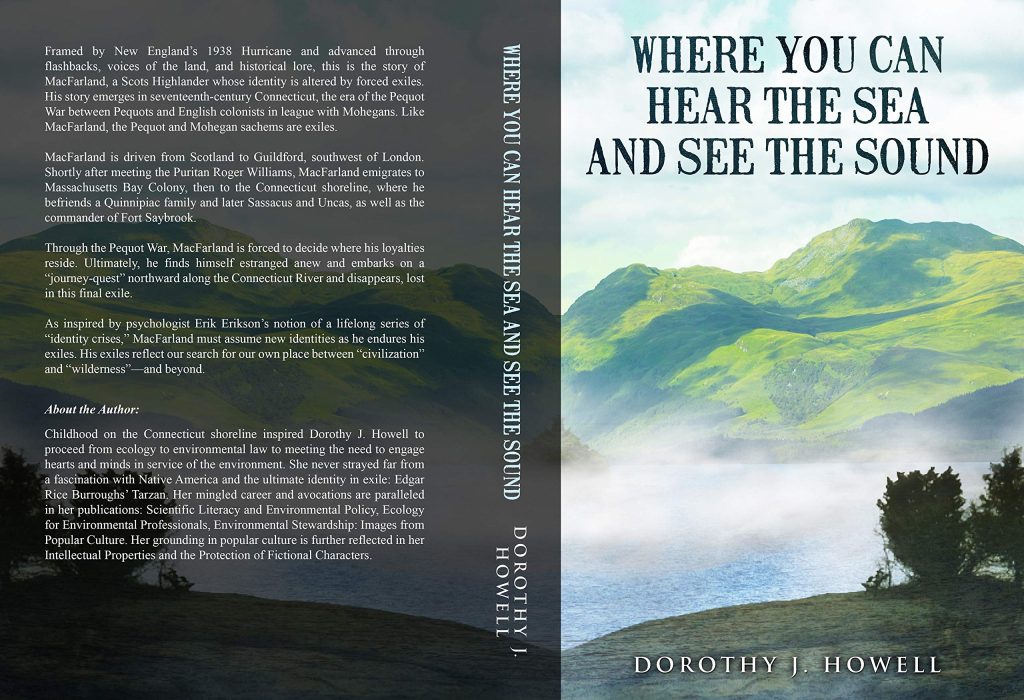
Framed by New England’s 1938 Hurricane and advanced through flashbacks, voices of the land, and historical lore, this is the story of MacFarland, a Scots Highlander whose identity is altered by forced exiles. His story emerges in seventeenth-century Connecticut, the era of the Pequot War between Pequots and English colonists in league with Mohegans. Native exiles are portrayed through Pequot sachem Sassacus and the Mohegan Uncas. MacFarland is driven from Scotland to Guildford, southwest of London. Shortly after meeting the Puritan Roger Williams, MacFarland emigrates to Massachusetts Bay Colony, then to the Connecticut shoreline, where he befriends a Quinnipiac family and later Sassacus and Uncas, as well as the commander of Fort Saybrook.Through the Pequot War, MacFarland is forced to decide where his loyalties reside. Ultimately, he finds himself estranged anew and embarks on a “journey-quest” northward along the Connecticut River and disappears, lost in this final exile.As inspired by psychologist Erik Erikson’s notion of a lifelong series of “identity crises,” MacFarland literally assumes new identities as he matures in the Highlands and endures his series of exiles, his life immersed in Puritanism and local histories and cultures. All our lives integrate such elements; we all are identities in exile, in search of our proper place somewhere between “civilization” and “wilderness.” We, like MacFarland, are on a metaphoric journey-quest elucidating our relationships with places, larger environments, the natural world, and realms beyond what we call natural.

Additional information

book-author

Dorothy J. Howell

book-author

Reviews

There are no reviews yet.

Be the first to review “Where You Can Hear the Sea and See the Sound”

Your email address will not be published. Required fields are marked *

ABOUT AUTHOR

Learn About The Book Writer

Dorothy J. Howell

Dorothy J. Howell

Childhood on the Connecticut shoreline inspired Dorothy J. Howell (“DJ”) to proceed from ecology to environmental law to meeting the need to engage hearts and minds in service of the natural environment. She never strayed far from a fascination with Native America and the ultimate identity in exile: Edgar Rice Burroughs’ Tarzan. Her mingled career and life path are paralleled in her publications listed here, with the novel Where You Can Hear the Sea and See the Sound, exploring our relationships to natural environments through formative places special to us – and what follows from the loss of those places. Her grounding in popular culture is further reflected in her Intellectual Property and the Protection of Fictional Characters, not “African Studies” but a still-useful guide to those who have created fictional characters who strike a chord with audiences. The author’s career has taken her from applied microbial ecology in State government to environmental law as an Illinois Assistant Attorney General in the Environmental Control Division and on behalf of two major corporations in the formative years of expanding federal pollution control programs. From that background she turned to academia, starting with a fellowship with Boston University’s Center for Technology and Policy followed by teaching and administration for Vermont Law School’s Environmental Law Center. From there she entered the first class of Antioch New England’s pioneering Environmental Studies doctorate while moving through an array of faculty situations in New Hampshire, Vermont, and Connecticut. Antioch fostered Where You Can Hear the Sea and See the Sound as her dissertation in keeping with the university’s call to reach out to audiences outside academia. For the last 15 years she has been an Adjunct Professor in Quinnipiac University’s First Year Writing Program. Constants through the author’s life have been immersion in popular culture and seeking to educate others in the liberal arts, law and policy, and the crafts of reading and writing. In fact, she is most at home in reaching out to others in terms of what has come to be known as cultural ecology: human relationships with the world around us. Childhood on the Connecticut shoreline inspired Dorothy J. Howell (“DJ”) to proceed from ecology to environmental law to meeting the need to engage hearts and minds in service of the natural environment. She never strayed far from a fascination with Native America and the ultimate identity in exile: Edgar Rice Burroughs’ Tarzan. Her mingled career and life path are paralleled in her publications listed here, with the novel Where You Can Hear the Sea and See the Sound, exploring our relationships to natural environments through formative places special to us – and what follows from the loss of those places. Her grounding in popular culture is further reflected in her Intellectual Property and the Protection of Fictional Characters, not “African Studies” but a still-useful guide to those who have created fictional characters who strike a chord with audiences. The author’s career has taken her from applied microbial ecology in State government to environmental law as an Illinois Assistant Attorney General in the Environmental Control Division and on behalf of two major corporations in the formative years of expanding federal pollution control programs. From that background she turned to academia, starting with a fellowship with Boston University’s Center for Technology and Policy followed by teaching and administration for Vermont Law School’s Environmental Law Center. From there she entered the first class of Antioch New England’s pioneering Environmental Studies doctorate while moving through an array of faculty situations in New Hampshire, Vermont, and Connecticut. Antioch fostered Where You Can Hear the Sea and See the Sound as her dissertation in keeping with the university’s call to reach out to audiences outside academia. For the last 15 years she has been an Adjunct Professor in Quinnipiac University’s First Year Writing Program. Constants through the author’s life have been immersion in popular culture and seeking to educate others in the liberal arts, law and policy, and the crafts of reading and writing. In fact, she is most at home in reaching out to others in terms of what has come to be known as cultural ecology: human relationships with the world around us.

Related products

BookFuel Search